
Why High-Performing Leaders Get Trapped: Self-Awareness, Self-Belief and Self-Care
From the outside, senior leadership often looks composed. The numbers move, the deal closes, the board pack lands polished, and the person at the table appears steady. But that does not always mean things feel steady on the inside.
Often, the strain stays less visible than anyone expects. Deadlines still get met. Performance still looks strong. The organisation still appears well held. Yet many leaders know the quieter reality of carrying too much for too long while also being the person everyone else looks to for clarity.
When your role trains you to be the one with the answers, a particular kind of isolation can follow. Over time, you can spend more energy managing crises, expectations, personalities, and your own fatigue than leading with perspective. From the outside, that may still look like strength. From the inside, it can feel like carrying too much for too long.
That is also why simplistic advice so often misses the mark. For leaders carrying commercial risk, people responsibility, and constant scrutiny, stress rarely yields to a quick technique or a new app. The more useful question is what actually helps someone stay clear, steady, and effective over time.
In my experience, three things sit near the centre of that: self-awareness, self-belief, and self-care. These are not soft additions to serious work, but practical capacities that shape judgment, presence, and stamina. When leaders neglect them, even very capable people can start operating below the level their role demands.
Self-Awareness - Beyond the Theoretical Mirror
Most senior teams know psychometrics, assessments, and 360 feedback well. These tools can help. They give language to patterns and help a leader reflect on how others experience them.
But recognising yourself in theory differs from noticing yourself in the moment when pressure rises.
Self-awareness is less about what a profile says on paper and more about what you do in a difficult meeting, a stretched week, or a decision with real consequence. It lets you notice your patterns, assumptions, and triggers as they arise, and choose your response more intentionally.
The Limits of Executive Objectivity
Many senior leaders see themselves as objective, often with good reason. They make decisions under pressure and weigh complex information quickly. But objectivity becomes harder to hold when habits, stress, or identity quietly shape the room.
Reactivity often shows up in senior environments like this -
You take on too much because delegating feels riskier than carrying it yourself.
You speak more forcefully to cover a brief moment of uncertainty.
You move too quickly to solve a problem instead of giving the team room to think.
Research on decision fatigue published on SSRN highlights something many leaders will recognise repeated decisions, constant interruptions, and cognitive overload steadily erode judgment. Over the course of an overloaded day, even a strong strategist can become more reactive, less discerning, and more likely to narrow the options too quickly.
When Reactivity Becomes a Bottleneck
When reactivity starts setting the pace, leadership can narrow without anyone intending it. Teams often become more cautious. People wait to read the room before they speak. Ideas arrive more polished and less exploratory because unfinished thinking can feel harder to bring forward.
Over time, that can create a culture of compliance rather than contribution. The business may still function well enough on the surface, but it no longer draws fully on the judgment and initiative available within it.
The more useful question is how this shows up in your own leadership.
When a transaction turns or a key client wavers, what happens to your tone? Does your language tighten and grow more defensive, or does it stay thoughtful and clear? Knowing yourself often means noticing your defaults when pressure strips away the comfort of control.
Self-Belief - When Capability Outruns Confidence
Many accomplished leaders carry private doubts about whether they are really as capable as others believe. The higher the stakes, the easier it becomes to misread ambiguity as inadequacy, even when the evidence of competence is already there.
Self-doubt does not stay confined to early career stages, and it does not disappear once someone reaches senior leadership. If anything, it grows more subtle. In more complex roles, leaders can easily mistake the natural uncertainty of leadership for personal deficiency.
What It Costs to Play Smaller Than Your Capability
In competitive environments, self-belief is not just personal; it shapes how a leader contributes, influences, and is seen. Many leaders, particularly women, have been socialised to hold back, edit their views, or wait for certainty that rarely comes at senior level.
The pattern is a familiar one, and the data reflects it clearly -
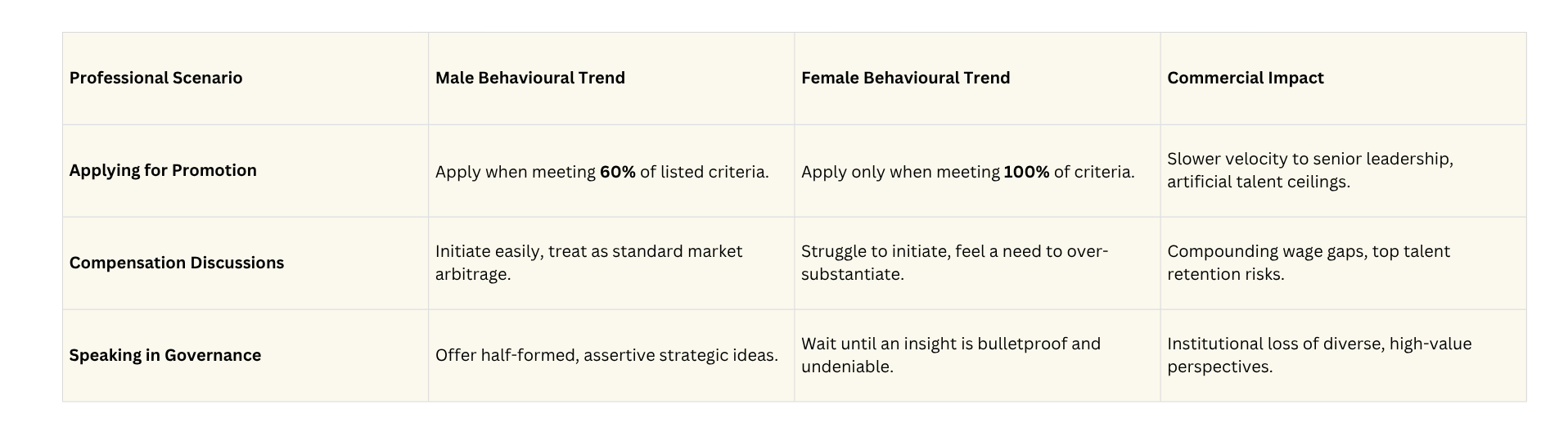
These patterns appear consistently across workplace research. When capable people screen themselves out of opportunities, discussions, or decisions, organisations lose perspective, initiative, and range.
Borrowing Belief Until It Becomes Your Own
At the edge of a larger role, self-belief does not always arrive fully formed. Often, it grows through good feedback, clear challenge, and the steady presence of someone who sees your capacity more clearly while you are still adjusting to it yourself.
Sometimes that means leaning, for a time, on someone else’s steadier view of what you can already do.
That is not about reassurance for its own sake. It is about working with someone who helps separate signal from noise, reflects your strengths back without exaggeration, and notices where hesitation obscures sound judgment.
If you find yourself repeatedly holding back what you can see, ask what the organisation loses as a result. In many senior settings, the issue is not capability but permission: the internal permission to speak before the view is perfect, to take up space without over-qualifying, and to trust hard-earned judgment.
Self-Care - Protecting the Primary Asset
Self-care can be a difficult phrase in senior leadership circles because people often reduce it to something occasional or cosmetic. Rest, retreat, and space away can be deeply valuable, but they help most when they support the way a leader actually works and lives.
For senior leaders, self-care becomes more useful when we understand it as the ongoing protection of judgment, energy, and capacity.
That can include rest and recovery, but it also includes boundaries, honest conversations, and practical decisions about what you will continue to carry, what you will delegate, and what is no longer sustainable. At this level, caring for yourself is inseparable from protecting the quality of your leadership.
The Cost of Burnout
Executive exhaustion is often treated as part of the job, even as proof of commitment. But sustained over-functioning carries a cost, not only for the individual leader but for the business around them.
The data is hard to ignore. Vistage found that 32% of small and midsize business leaders report feeling burned out or emotionally exhausted on a regular basis. Research from the Harvard Business Review and Deloitte points in the same direction, with 80% of senior leaders reporting exhaustion associated with burnout.
That depletion usually shows up in three places -
Retention and Attrition - research from IMD Business School shows a sharp acceleration in executive churn, with CEO departures spiking significantly under the compounding weight of isolation and unmanaged stress.
Productivity Loss - according to workplace performance metrics published on PMC, moderate to high levels of emotional exhaustion correlate directly with major productivity losses, driving up absenteeism and presenteeism across leadership teams.
Financial Value Destruction - multimedia economic analyses show that unmanaged leadership burnout can cost mid-to-large organisations millions of dollars annually through slower execution, missed market transitions, and operational errors.
The Discipline of a Hard Boundary
Boundary-setting is often framed as a personal preference, but in senior roles it is also an operational choice. Without it, time fragments, attention narrows, and judgment grows more vulnerable to fatigue.
Saying yes too often, stepping into every dispute, and remaining permanently available can look like commitment. Sometimes it is. But it can also become a way to stay occupied by the urgent while leaving too little room for the reflective, strategic work only you can do.
Protecting that capacity often means having difficult conversations with co-founders, partners, clients, or teams. It means designing ways of working that respect the fact that your judgment is one of the most valuable resources in the business.
When decision fatigue builds, leadership tends to contract. It becomes harder to spot opportunity early, hold complexity well, and bring steadiness to other people when the environment is demanding.
Getting Out of Your Own Way
The patterns that helped you reach your current level of success can also limit what comes next. Relentless attention to detail, the instinct to carry too much yourself, and the habit of screening out your own human needs may once have earned rewards. At a certain point, they start costing more than they give.
What you may need is not another tool, but a different relationship with your own authority, capability, and energy.
For many leaders, that shift begins when they see more clearly where old strengths have become constraints, and where a steadier way of leading is starting to emerge.
When you look at your firm, your practice, or your leadership team, where do you sense the strain starting to show? If you continue at your current pace for the next eighteen months, what are the likely consequences for your health, your people, and the business itself?
These are not easy questions, but they are often the ones that matter most if you want your leadership to stay sustainable as well as effective.
Perhaps the more useful question is not how much longer you can keep carrying it this way, but what might change if you no longer had to.
If any part of this feels familiar, it may be worth taking a quieter look at where your leadership is asking for more support, more honesty, or a different kind of steadiness. That conversation is often where meaningful change starts.
Soulitude7 supports senior leaders in approaching this work with greater clarity, steadiness, and perspective.
(Sources used and to whom we owe thanks – Freeda En; Harvard Law School; Cerevity; LinkedIn; ABC News; National Library of Medicine; IMD; SSRN; Deloitte; Harvard Business Review; Harvard Business School; Gender, Competition, & Confidence with Methodological Insights: Experimental Evidence by Brianna Noelle Halladay and Ladyboss).